Saturday, January 8, 2011

1st Death Anniversary Announcements

Iran discovered in south-eastern city '5 thousand

Iranian archaeologists have discovered in the south-east of the country the remains of a city that dates back over five thousand years ago. The Fars news agency reported, explaining that the discovery was made by chance during the construction of a building project in the region Khajeh Askar, near the city of Bam, Kerman province. "Part of the ruins was unfortunately damaged during the excavation - the archaeologist said Nader Soleimani Alidade - The artifacts found at the site show that this is one of the oldest residential areas all over Iran."
"The inhabitants of the site were in contact with other communities Time - added the scholar - including Jiroft civilization, which flourished in the third millennium BC and it was also discovered by accident in 2001, following a flood of Halil Roud River, divenedo soon for archaeologists for the richness of the finds, a true 'lost paradise'. Among the artifacts found at the new site, many pottery, which seems to show that the city's inhabitants did not use the wheel to model different.
were also identified two cemeteries and skeletons of a man and a woman, either buried in a fetal position. In addition to skeletons, there were several items, including some shells used as containers for cosmetics. The province of Kerman is home to one of the most important archaeological sites in Iran, including the historic city of Bam, the largest brick structure in the world, proclaimed World Heritage Site by UNESCO and almost completely destroyed by an earthquake in 2003.

Susage Dog For Drafts

years ago the first modern man could have appeared in Israel

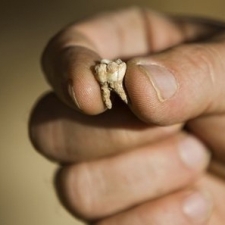
It was long believed that modern man had emerged from Africa 200,000 years ago. Now at Tel Aviv University archaeologists have discovered evidence that Homo sapiens wandering in the area now corresponding to the state of Israel 400,000 years ago and would be the first evidence of modern humans throughout the world.
The results have been found in Qesem Cave, a prehistoric site that is close to Rosh Ha'ayin that before had been dug in 2000. Prof. Avi Gopher and Dr. Ran Barkai Department of Archaeology of Tel Aviv, which handles the excavations, and Prof. Israel Hershkowitz of the University Department of Anatomy and Anthropology Sackler School of Medicine, along with an international team of scientists has performed an analysis morphological eight human teeth found in the cave Qesem.
analysis, which included a CT scan and X-rays, indicates that the size and shape of the teeth are very similar to those of modern man. The teeth found in the cave Qesem are very similar to other evidence of human presence in the area corresponding to the modern state of Israel, dated about 100,000 years ago, discovered in the cave of Skhul in Caramel and in the Qafzeh cave in Lower Galilee near in Nazareth. The results of the researchers 'findings' are being published in the Journal of Physical Anthropology.
Reading the past
Qesem Cave is dated in a period between 400,000 and 200,000 years ago, and archaeologists working there believe that the results indicate significant changes in the behavior of ancient man. This period was crucial in the history of mankind under the terms of culture and biology. The teeth that are being studied indicate that these changes are apparently related to the evolutionary changes taking place at that time.
Prof. Dr. Barkai and Gopher have found that the results for the culture of those who lived in the cave Qesem - including the systematic production of blades of flint, the use regular fire, hunting tests, cutting and sharing of animal flesh and use of mineral raw materials to produce flint tools from underground sources - reinforce the hypothesis that this was in fact the conduct innovative and pioneering may correspond with the emergence of modern man.
A discovery unprecedented
According to the researchers, the findings made in the Cave Qesem could have reversed the theory that modern man is born in Africa. In recent years, archaeological evidence and human skeletons found in Spain and China have undermined this position, but the results Qesem the Cave, because of the time recently to which they refer, are an unprecedented discovery.
Qesem continue excavations in the cave and the researchers hope to discover additional artifacts that will allow them to confirm the results published so far, to improve our understanding of the evolution of the human race - in particular the emergence of modern man .

on GaiaNews

Sunday, January 2, 2011

How Do Herps On The Feet Look Like

New Year. After S. Mass street in the snow!


January 2, 2011

ADS ON Leader and skiing on snow in the hills of Magura.

E 'was an unforgettable afternoon, which had a great time. Those who knew the art of a little slip on the snow, they had the willingness to help those less experienced. Between falls and abundant spins have sipped glasses of hot tea.
With the Oratory Don Bosco group of Bacau were also the youth of the Parish of Margineni, who were led by Don Paul.
skis and sleds, with two old bob, were replaced by plastic bags.
But the absence of sophisticated systems for sliding on snow, did not take off, it even increased the joy and the thrill of "skiing" ...